On the 5th of
October, Queensland, the Australian Capital Territory, New South Wales,
and South Australia will be observing the Labour Day public holiday. As the
Readysell head office is located in New South Wales, the office will be
closed, but our normal ‘after-hours’ support is available for critical
issues. We will have a staff member on call to respond to any critical
issues that arise.
Over the weekend it became apparent that there was an issue with the integration between GNS and Readysell – because of a change that GNS affected to their systems on Friday.
Readysell has worked with GNS and we are pleased to announce we now have a solution get GNS EDI integration from Readysell working again! The solution must be setup at each business individually. Shannon, on our support team, has already started rolling out the change to some businesses today – starting with those businesses that have put in support tickets. Shannon will continue to roll out the change (including to your business) over the next few working days.
In the meantime, until the change is rolled out to your business, the workaround to this issue is still to send purchase orders to GNS via email. Use the “Send” button on purchase orders or email batches to send your purchase orders to GNS via email.
If you have any questions or if you need any further assistance. Please contact Readysell support.
Over the weekend it became apparent that there was an issue with the integration between GNS and Readysell – because of a change that GNS affected to their systems on Friday. At the current moment, this latest change is not allowing our customers to send their purchase orders via EDI to GNS.
GNS informed us late on Friday of the change they had made to their system and gave our team instructions on the minimal changes required to Readysell in order to ensure that the systems continued to operate together. While our team made the requested changes immediately, unfortunately these did not work as we were told, and issues arose with this functionality over the weekend.
GNS are currently working on a resolution, and our team will be communicating with them constantly, to ensure the duration of this issue is as short as possible. We will update you all as the fix progresses.
In the meantime, the workaround to this issue is to send purchase orders to GNS via email. Use the “Send” button on purchase orders or email batches to send your purchase orders to GNS via email.
Readysell has just discovered that online orders are not flowing through to the Readysell system. Office Brands are aware of the issue, and are working as quick as possible to resolve this matter. There currently is no ETA on when this will be resolved.
In the meantime, if you need online orders shipped please manually enter these into the Readysell system for processing.
In response to a spike in demand for advice around stocktakes over the last few days, Readysell will be running two half hour stocktake training webinars over the next few days:
Wednesday 24/06/2020 at 1:00 on Sydney time
Thursday 25/06/2020 at 1:00 on Sydney time
If you are doing a stocktake in the next few weeks, we advise you to attend.
Please Join the Zoom Meeting by clicking the link below:
One tap mobile
+61871501149,,7323973551# Australia
+61280156011,,7323973551# Australia
Dial by your location
+61 8 7150 1149 Australia
+61 2 8015 6011 Australia
+61 3 7018 2005 Australia
+61 731 853 730 Australia
+61 861 193 900 Australia
Meeting ID: 732 397 3551
Find your local number: https://zoom.us/u/abgF74IIZK
Don’t let the end of the financial year scare you! KeyPay is here to provide you with all the tools you’ll need to make wrapping up the Financial Year 2019/2020 as smooth as possible. This blog will help you with understanding key End of Financial Year (EOFY) tasks that need to be completed, and equip you with knowing how to implement them effectively within KeyPay.
Our EOFY resources at a glance: Webinars Our webinars are a useful way of gaining knowledge on how to access and utilise tools within KeyPay that will help you in the EOFY process. There are two topics offered:
Topic
Description
Details
End of Financial Year processing with Payment Summaries
This webinar is designed for businesses who have not yet started or are not required to start reporting to the ATO via STP. This includes WPN holders and businesses with closely held employees as they are exempt from reporting to the ATO via STP for this financial year.
This webinar will show businesses with these specific requirements how to generate payment summaries for their eligible employees by covering:
Tips on reconciling data to ensure everything is correct before processing payment summaries How to report FBT amounts on the payment summaries How to generate and publish payment summaries to your staff Methods of lodging payment summary data to the ATO ATO deadlines for lodging payment summaries with the ATO and providing that information to your employees Obligations for WPN holders and closely held employees for the new FY
*If you’re a business that has a combination of closely held employees and non-closely held employees, we recommend that you also attend our EOFY processing with STP Finalisation webinar.
End of Financial Year processing with STP Finalisation
This webinar is specifically for businesses that have already been reportng to the ATO for Single Touch Payroll during this financial year. We will show you how to process your End of Year using our purpose built Finalisation Wizard!
In this webinar, we’ll be covering:
Tips on reconciling data to ensure everything is correct before lodging finalisation event Using the EOFY wizard to report a finalisation event How to report FBT amounts via STP ATO deadlines for reporting your End of Year finalisation What your employee can expect to see via their myGov account Difference between Payment Summaries vs Income Statements and what it means to your employees
Relevant for businesses that are exempt from reporting STP, and have therefore chosen not to, during the 2019/2020 financial year.
This article will guide you through the process of wrapping up the 2019/2020 financial year, generating and lodging your employees’ payment summaries and getting ready for the 2020/2021 financial year.
Relevant for employers that have been reporting to the ATO for STP during this financial year, as well as all businesses which do not fall within the exemption for WPN holders and small businesses with closely held employees.
The article will guide you through housekeeping and then the finalisation process for the 2019/2020 financial year.
*Specifically for payroll administrators who have not been STP reporting for FY 19/20
Completed all of your End of Year Reconciliation? We walk you through publishing payment summaries and lodging PAYG payment summary reports to the ATO.
*Specifically for payroll administrators who have not been STP reporting for FY 19/20
Completed all of your End of Year Reconciliation? We walk you through publishing payment summaries and lodging PAYG payment summary reports to the ATO.
Everything you need to smoothly set up and roll out STP within KeyPay.
Topics covered include how to register for STP, STP guide, processing finalisation events, creating and lodging an amended finalisation event.
7 housekeeping tips for the End of Financial Year
By following our top housekeeping tips for End of Financial Year in KeyPay, you can avoid frustrating issues
1. Check employees’ Tax File Numbers: Ensure your employee’s Tax File Numbers are valid. If an employee’s Tax File Number has been entered as ‘111111111’, you should make sure you contact the employee for the correct data.
2. Do you have approved working holiday makers in your business? Check if your employee’s working holiday maker flag is correct: This can be done on the employee’s tax file declaration page.
3. Joined KeyPay mid-Financial Year? Importing your YTD balances to KeyPay means you only need to undertake one finalisation event or payment summary lodgement per employee. If reporting via STP, refer to our transitional options available to you.
4. Check if employees have Fringe Benefits Tax that needs to be reported: Reportable FBT must be entered separately – RFBA’s cannot be entered via pay runs.
5. Make sure reportable employer super contributions have been processed in the pay run.
6. Ensure your‘allowance’ pay categories and deduction settings are properly configured. 7. Reconcile your end of year lodgement data with your payroll report to ensure what you are lodging matches with what has been processed for the financial year. Refer to our recommended reconciliation tips for payment summary lodgement and STP finalisation events.
For a stress free EOFY, we strongly recommend commencing the above process as soon as possible. Fixing any configuration settings or invalid data before you start your end of year processes means you’ll have less reconciling to do after the final pay run of the financial year. It will be much less time consuming and you’ll be far less likely to have to make any adjustments after the fact!
Publishing Employee Payment Summaries and Lodging PAYG payment summary reports to the ATO
LAST UPDATED: 9 JUNE 2020
Note: This piece is specifically for payroll administrators who have not been STP reporting for FY19/20.
Publishing employee payment summaries Once you’ve completed all of your End of Year Reconciliation (if not, read here), you will be able to view the payment summaries yourself before they’re published to give you peace of mind.
Deadline for issuing employee payment summaries: 14 July
Once published, you can send a notification to employees at that time or schedule for whenever you choose. The employee will also have access to their payment summaries if they go to the employee portal or in the WorkZone app. For guidance on publishing Employee Payment Summaries, view our step by step instructions here.
Lodging PAYG payment summary reports to the ATO
The next step would be submitting PAYG payment summary information for your employees to the ATO. The ATO requires that all businesses submit PAYG payment summary information for their employees by August 14. To make this simpler for you, you can lodge the PAYG payment summaries electronically through KeyPay. Alternatively, if your preference is to lodge the EMPDUPE file through your business portal, we can also facilitate this.
Lodging electronically via SBR is the quickest method, but you must ensure you’re set up for electronic lodgement. To check if you’re set up:
1. Go to ‘Payroll Settings’ > ‘ATO Settings’ tab and make sure all this information is entered correctly. HINT: you can use the ‘copy from business settings’ option.
2. On the Electronic Lodgement & STP tab you will be able to see if you are enabled for electronic lodgement. If not, you can click on the Enable Electronic Lodgement option and this will direct you to our Single Touch Payroll set up process. For STP exempt businesses, this set up will allow electronic lodgement of payment summaries. Remember to register your software ID with the ATO first! Our Enabling ATO Integration for Single Touch Payroll article will assist with that.
3. If you have more than one employing entity set up in your business, don’t forget to enable electronic lodgement for all employing entities!
4. To check you are enabled, go to ‘Payroll Settings’ > ‘Employing Entities’. If you need to enable the employing entity click on the Enable Electronic Lodgement option within the relevant entity and confirm you have registered the software ID.
Once you’re set up, follow the steps in our support article to lodge via SBR. Alternatively, you can upload the EMPDUPE file to your ATO business portal. Click here for steps on how.
All things STP
LAST UPDATED: 9 JUNE 2020 Everything you need to smoothly set up and roll out STP within KeyPay.
STP is a government initiative that was introduced to streamline business reporting obligations. It started from 1 July 2019 for employers with 19 or less employees (businesses with 20 or more employees were required to be STP compliant in July 2018). In a nutshell, STP requires employers (or their registered agent/intermediary) to report payments such as salaries and wages, PAYG withholding and super information directly to the ATO from their payroll system. This must be reported after every pay run has been finalised but no later than the employee’s payment date.
How to register for STP
To help you get started, KeyPay has an STP registration wizard that you can easily follow to enter all the required business details, show you how to register the software ID with the ATO and enable the payroll software for the electronic lodgement of STP information to the ATO. You can access the wizard from two areas in the software: Payroll Dashboard ATO settings > Electronic Lodgement & STP tab
We’ve prepared an STP guide to help you navigate through all the necessary components required to undertake STP reporting. This includes changes to existing business settings, new configuration settings, how to create pay events and ultimately successfully lodging pay events.
KeyPay’s STP page is available to all businesses that have enabled STP and can be accessed via Reports > Single Touch Payroll (under the ‘ATO Reporting’ list) From here you can view the details of all historical events as well as perform other actions like creating a new pay run, creating an update event and launching the finalisation wizard More information regarding the STP page can be found here.
Validation Warnings in STP Events
This article lists the validation warnings set up within KeyPay that you may see once you have created a pay/update event. We have put these warnings in place to reduce the possibility of a failed or partially successful lodgement. However, please note, some errors can only be identified AFTER the event has been lodged with the ATO. STP: Processing Finalisation Events
There are 2 ways within KeyPay to lodge your finalisation event.
The support articles above will guide you through completing your end of year processing (ie processing a Finalisation Event) using each of those methods. Note that the STP EOFY Wizard does include additional functionality over an update event, being:
Ability to bulk import RFB amounts for employees; Send notification emails from the platform once the finalisation event has been successfully lodged; and
Accessing the amended finalisation event wizard if further finalisation events are required.
Creating and Lodging an Amended Finalisation Event
If, after having successfully lodged a finalisation event for your employees, you identify that an employee’s earnings need to be adjusted, you will need to lodge an amended finalisation event. This support article provides instructions on how to lodge an amended finalisation event for businesses reporting their end of year through STP. *Note: Employers are required to lodge the amendment no later than 14 days after having identified the need to do an amendment.
Managing failed or partially successful STP events
There may be instances where a pay event is deemed partially successful. The reason for this would be that one or more employee records failed. N.B. To clarify, all other employees whose records do not fail are successfully lodged with the ATO.
Just dropping you a quick note to let you know of features, enhancements and improvements we have recently released.
2020/2021 Tax Tables
Just confirming we have deployed the 2020/2021 financial year tax tables. This means users can create pay runs that contain pay dates for the next financial year.
2019/2020 End of Financial Year Processing
End of year is fast approaching! You can start preparing for this process as we have now released both the finalisation event and payment summary functionality for this financial year.
Additionally, you can access our support articles to guide you through the process, applicable to your scenario, as follows: STP Finalisation Events; Payment Summaries.
Don’t forget to register for our EOFY webinars! We’ll also have a central resource hub for everything end of year related that will be made available to you soon.
STP Earnings Reset Event
We have created a new event type that allows you to report $0 earnings against an employee, effectively wiping out earnings previously reported to the ATO. You would use an earnings reset event to reverse incorrect business and/or employee details, such as incorrect BMS ID, employee Id, employing entity, etc previously lodged for an employee.
Refer to our support article for further information on how this works
JobKeeper & Payroll Tax
It has been confirmed that all States and Territories have applied a payroll tax exemption to JobKeeper wages. As such, we have updated all system generated JobKeeper pay categories to classify them as payroll tax exempt. This update also applies the exemption retrospectively, ie to pay runs already processed using the pay categories
If you have created your own JobKeeper pay categories, we suggest you update the payroll tax exempt setting accordingly to ensure your payroll tax reporting is correct.
Modern Awards & Annual Wage Review
Normally at this time of the year, the Fair Work Commission would have announced their decision regarding the national minimum wage. This year, however, the timelines for consultations, submissions, etc have been stretched out. What does that mean? Basically, there is no definitive timeframe as to when an announcement will be made. It’s seemingly unlikely that award wage updates will occur from 1 July, however you can never say never.
We will obviously be staying abreast of this exciting development and keep you informed of any updates along the way.
We’re pleased to announce that Readysell 8.58 (codename Victoria) is rolling out to all of our Readysell 8 customers. This release is focused on implementing some important backend enhancements, as well as actioning bugs that have been reported.
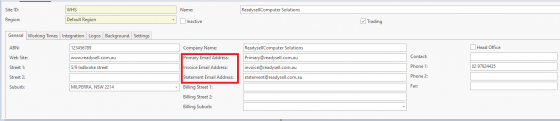
Allow for optional email addresses to be added to the site module.
We have now given the ability to have an optional email address for Statement and Invoice layouts. This allows sites to have a different email address to the primary email address. These are not primary fields so if you leave them blank, the Statement and Invoice layouts will use the primary email address.
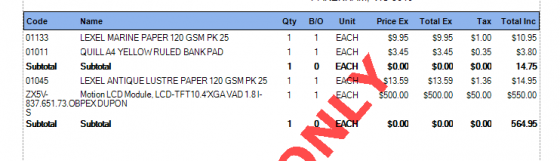
Added the ability to now subtotal lines on Service orders
You can now create a subtotal product that will add a dollar value total to the products placed above it. Should read as:
Add the ability to include Backorders on the Stock Replenishment Run
Stock replenishment run now has the ability to include sales backorders to top-up products stock quantity level when it reaches a predefined product minimum replenishment quantity.
This is a feature used for stores that have multiple sites and would like to top-up stock on hand from one site to another.
But wait, there’s more…
We’ve also made a number of other improvements and under-the-hood changes. Here’s a full list. If you’d like more details about any of the below items, please don’t hesitate to get in touch with us through the Readysell Helpdesk.
15523 Allow for supplier debits to import duplicate entries.
15537 Error displays when you click “Send Favourites to the website”
15538 Refresh balance task not updating the Balance and Budget
15556 Create an API for “Custom Field 1”
15557 Accounts header closing balance does not sync with total account children closing balance


 In response to a spike in demand for advice around stocktakes over the last few days, Readysell will be running two half hour stocktake training webinars over the next few days: